Machine Learning (Part 7): Understanding Generative Adversarial Networks (GANs)

Welcome back to our Machine Learning journey! In this part of the series, we're delving into Generative Adversarial Networks, often abbreviated as GANs. Much like an artist learning to create lifelike paintings, GANs are designed to generate data that's so realistic, that it can be indistinguishable from the real thing.
If you have missed out on the previous part, then please Click here.
Without further due, let's break down GANs!
What are Generative Adversarial Networks (GANs)?
Imagine having two competing artists—one trying to create the most convincing fake currency, and the other trying to detect the counterfeits. This artistic duel represents the essence of GANs. GANs consist of two neural networks: a generator and a discriminator. The generator's role is to create counterfeit data, while the discriminator's job is to distinguish real data from fake.
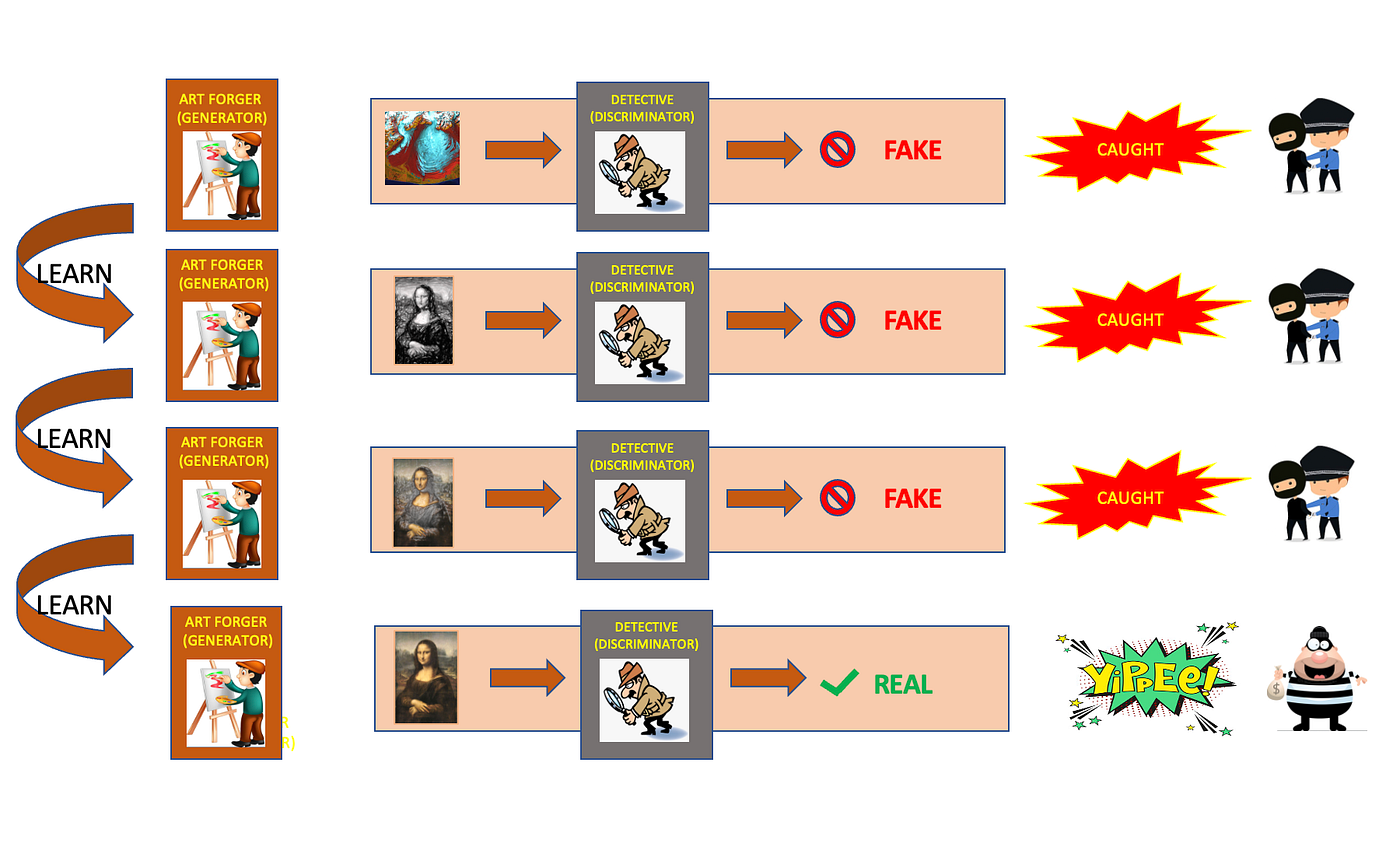
Think of GANs as a duo of forgers and detectives. The forger (generator) tries to create counterfeit paintings that look like famous artworks, while the detective (discriminator) inspects these paintings to spot the fakes. The forger keeps improving their skills until the detective can't tell the difference.
The Process of Generative Adversarial Networks
GANs follow a captivating process of competition and cooperation between the generator and discriminator:
Generator's Role
The generator takes random noise as input and tries to produce data that resembles the real thing.
It keeps improving its skills over time through training.
Discriminator's Role
The discriminator assesses data, attempting to distinguish real from fake.
It also refines its abilities through training.
Adversarial Training
The generator and discriminator engage in a constant duel.
The generator strives to create increasingly convincing data, while the discriminator sharpens its detection skills.
This adversarial training continues until the generator produces data that are almost indistinguishable from real data.
Convergence
Eventually, the generator becomes so adept at creating realistic data that the discriminator can't tell the difference.
At this point, the GAN has reached a state of equilibrium, and the generated data is remarkably authentic.
Common Generative Adversarial Networks
Let's explore some of the common GAN architectures and their applications:
Vanilla GAN
Imagine a skilled artist (the generator) trying to create a masterpiece, while a vigilant art critic (the discriminator) critiques each painting. The artist keeps refining their work until the critic can't distinguish real art from the artist's creations.
How it Works:
The generator takes random noise as input and creates data, e.g., images.
The discriminator evaluates these images, trying to tell if they are real or generated.
Through adversarial training, the generator improves its skills, making the generated data more realistic.
This competition continues until the generated data is virtually indistinguishable from real data.
When to Use: Vanilla GANs are suitable when you want to generate data that closely resembles real data, such as generating lifelike images, audio, or text.
Example: Generating high-quality, photorealistic images of celebrities, even though those celebrities don't exist. These generated images can be used for various applications, including art, entertainment, or data augmentation.

DCGAN (Deep Convolutional GAN)
Think of a painter equipped with a set of magic brushes (convolutional layers). These brushes help the artist create highly detailed and realistic paintings (images) with incredible accuracy.
How it Works:
DCGAN enhances GANs with convolutional layers, which are particularly effective in image generation.
It uses deep neural networks to learn complex patterns in data.
DCGANs are well-suited for image generation tasks, as they can capture fine-grained details and textures.
When to Use: DCGANs are ideal for tasks that require high-quality image generation, such as generating realistic faces, artwork, or objects.
Example: Creating detailed, lifelike images of animals for use in wildlife conservation simulations or video game design.

CGAN (Conditional GAN)
Imagine a painter who takes specific requests. Instead of randomly painting, they can create art based on the viewer's preferences. This is what a CGAN does—generating data conditioned on specific information.
How it Works:
CGANs take additional information (like labels or attributes) alongside random noise to generate data.
They can produce data tailored to certain conditions or requirements.
CGANs are useful for tasks like image-to-image translation or generating data with specific attributes.
When to Use: CGANs are valuable when you need to generate data with specific characteristics, such as converting photos into different art styles or generating images of cats with particular colors and poses.
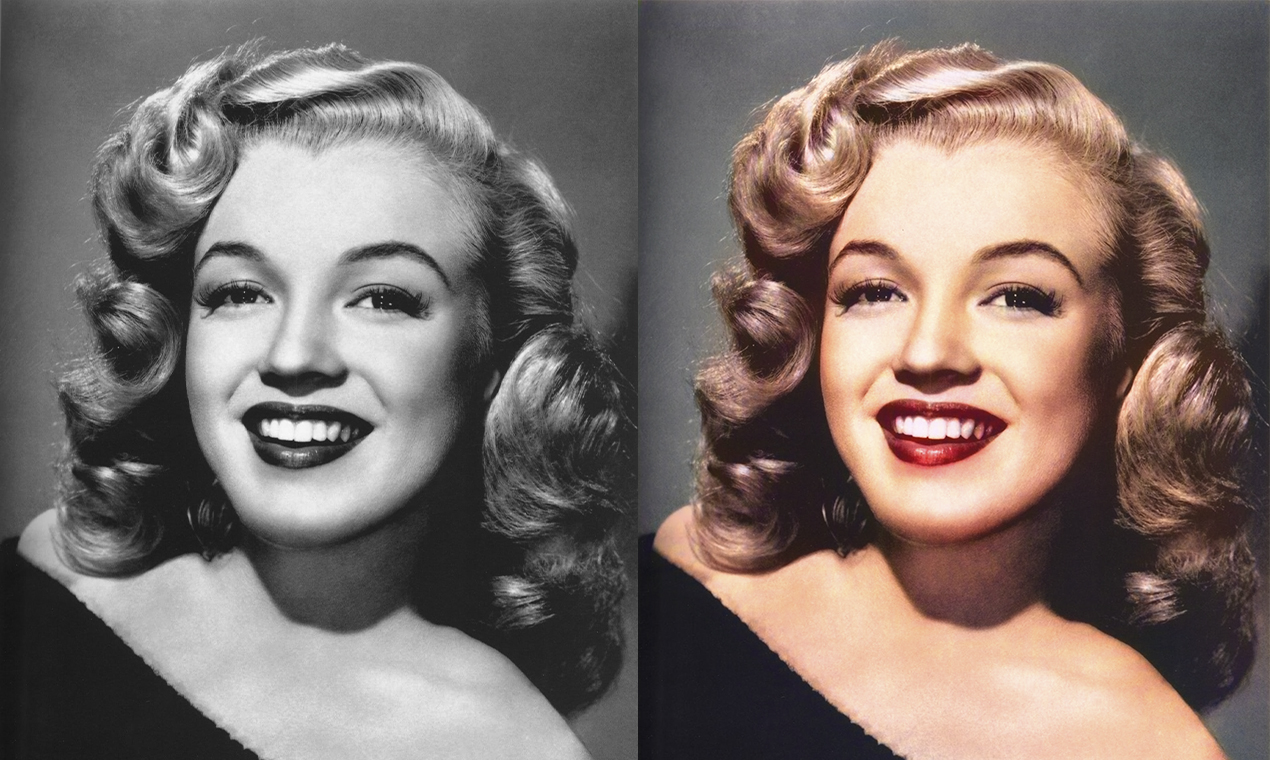
Example: Turning black-and-white photos into color images while preserving the original content, style, and color coherence.
CycleGAN
Think of a magical portal that can transform one landscape into another. CycleGAN is like that portal—it can convert data from one domain into another without the need for paired training data.
How it Works:
CycleGAN uses a cycle-consistency loss to ensure that data can be transformed from one domain to another and back again without losing essential information.
It's particularly useful when paired data (examples of both domains) is scarce or unavailable.
When to Use: CycleGAN is beneficial for image-to-image translation tasks where you want to transform data from one style or domain to another, such as turning photos into paintings or changing day scenes into night scenes.
Example: Converting satellite images of urban areas into maps, making it easier to navigate and understand the layout of a city.

StyleGAN
Imagine an artist who can not only paint but also control every detail of their masterpiece. StyleGAN allows you to have this level of control over the generated data, making it highly customizable.
How it Works:
StyleGAN lets you adjust various aspects of the generated data, such as its style, content, and level of detail.
It offers fine-grained control, making it perfect for creating customizable content like artwork or avatars.
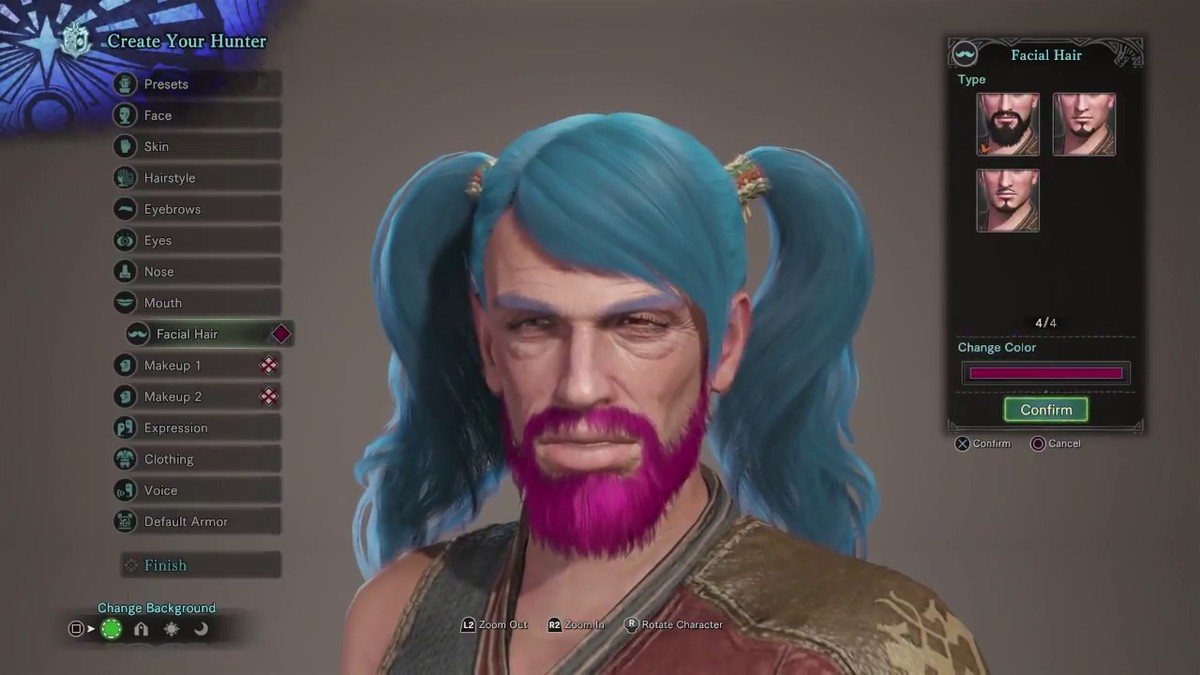
When to Use: StyleGAN is ideal when you need to generate highly detailed and customizable data, such as creating unique characters for video games or personalized artwork.
Example: Generating highly detailed, customizable 3D characters for a virtual reality game, where players can modify every aspect of their in-game avatar.
When to Use Generative Adversarial Networks
GANs are ideal when you want to:
Generate realistic data, such as images, music, or text.
Enhance the quality of data for training machine learning models.
Perform tasks like image-to-image translation, super-resolution, or style transfer.
Create art, simulate real-world scenarios, or generate synthetic data for research.
Advantages and Challenges
Advantages
Realistic Data Generation: GANs excel at generating data that closely resembles real-world data, whether it's images, text, or audio. This realistic data can be used for various applications, including computer vision, speech synthesis, and data augmentation.
Data Augmentation: GANs can create additional training data, which is particularly valuable when working with limited datasets. This helps improve the performance of machine learning models by providing more diverse examples.
Artistic Expression: GANs have been employed in art and creative fields to generate unique and novel pieces of artwork, music, and even poetry. They empower artists and creators to explore new frontiers in digital art.
Style Transfer: GANs enable the transformation of data from one style or domain to another. For example, they can convert photographs into various artistic styles, making them versatile tools for image editing and creative projects.
Super-Resolution: In image processing, GANs can enhance the resolution and quality of images, making them useful in applications like medical imaging and satellite image analysis.
Image-to-Image Translation: GANs can map images from one domain to another, such as turning satellite images into maps or black-and-white photos into color images.
Challenges
Complex Training: Training GANs can be challenging and time-consuming. Achieving a balance between the generator and discriminator is critical, and it often requires extensive hyperparameter tuning.
Mode Collapse: GANs may suffer from mode collapse, where the generator produces a limited set of outputs, ignoring the diversity of the data distribution. This can result in a lack of variety in generated data.
Need for Large Datasets: GANs typically require large datasets for effective training. When data is scarce, GANs may struggle to generate high-quality outputs.
Training Instability: GANs can be sensitive to hyperparameter choices, and training can be unstable. Slight changes in parameters or data can lead to the generator and discriminator getting stuck or producing poor results.
Evaluation Challenges: Assessing the quality of generated data is not always straightforward. Metrics for evaluating GAN-generated data can be subjective, making it challenging to determine when a GAN has succeeded in producing realistic outputs.
Ethical Concerns: GANs can be misused to create deepfake content, fake news, or counterfeit art and products, raising ethical and legal concerns regarding authenticity and trust in digital media.
Real-time Applications
Image Generation: GANs can create lifelike images, such as generating faces that don't exist or converting sketches into realistic pictures.
Data Augmentation: GANs can generate additional data to improve the training of machine learning models.
Style Transfer: They can transform photos into artistic styles, mimicking famous painters' techniques.
Conclusion
In our exploration of Generative Adversarial Networks, we've understood that GANs continue to push the boundaries of what's possible in the world of artificial intelligence, opening doors to artistic expression, data generation, and so much more. In the next part, we'll delve into the realm of Natural Language Processing (NLP) and its applications in understanding and generating human language. Until then, stay curious and continue your journey in Machine Learning!


